
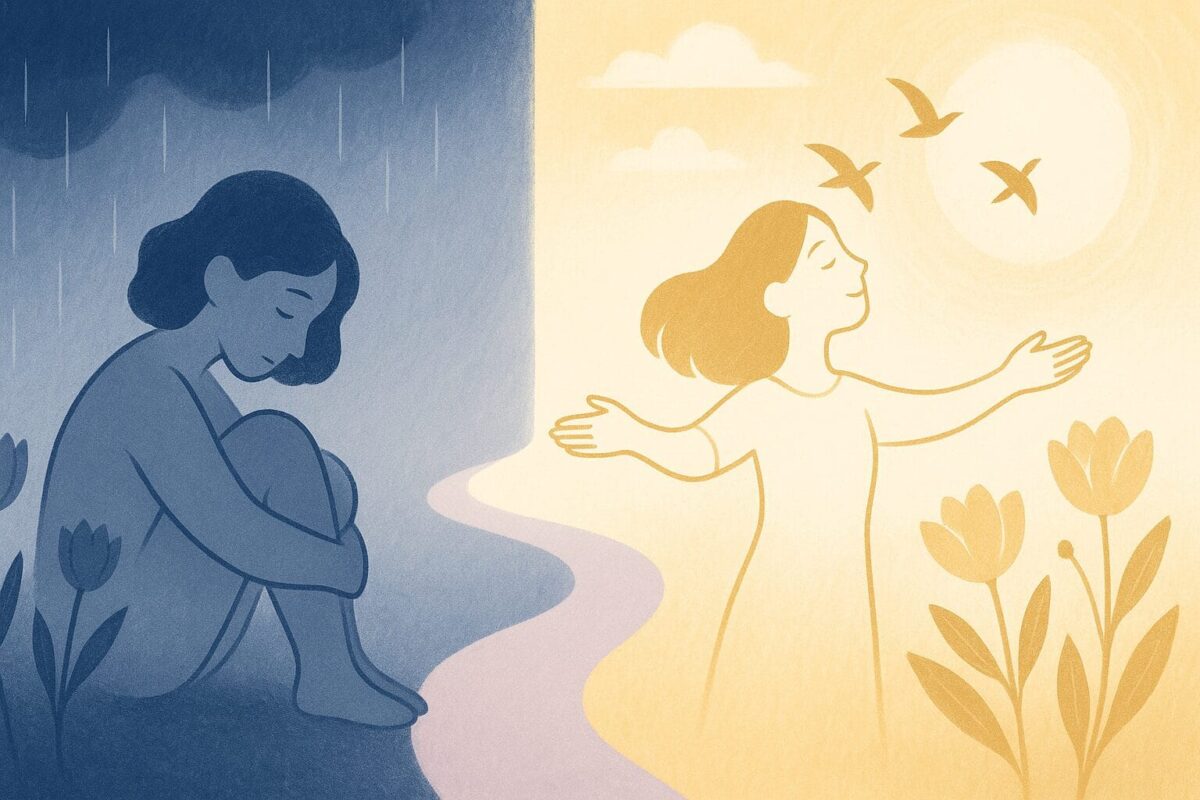
Important Note: This article is a personal testimony about grief and eating disorders. If you are struggling with eating disorders, depression, or suicidal thoughts, please seek guidance from a qualified mental health professional. This content is for informational and inspirational purposes only and does not replace professional counseling.
How to Deal With Grief When Faith Collapses
Learning how to deal with grief has been the most painful experience of my life. There are people who believe that unshakeable faith means not falling apart, that spirituality requires permanent serenity, and that those who trust in something greater never question, fear, or suffer. I believed that too, until life taught me a painful truth: even the strongest faith can tremble, and when it does, it falls hard.
When I lost my second child, every belief I had was shattered. No spiritual teaching had prepared me for this reality. I had no idea how to deal with grief, especially when it lived inside a heart that believed faith alone could protect me from devastation.
My oldest son was only four years old when everything happened. He was beginning to understand what family, presence, and protection meant. I, meanwhile, was discovering how it felt to lose all ground beneath my feet. No prayer, mantra, or energy practice could bring my child back. My faith collapsed, and with it, I collapsed too.
In the first days, nothing made sense. Spiritual lessons, divine explanations, and cosmic purposes felt empty in the face of such a raw loss. The pain was too deep. I kept asking myself: how to deal with grief when your faith fails you? In that moment, I had no answers. Only silence.
When Pain Becomes Isolation and the Body Starts to Speak
After the loss, a storm I did not expect began. I developed an intense fear of people. Their well-intentioned hugs, words, and looks cut through me like blades. Because of that, I slowly withdrew. I distanced myself from friends, from family, and even from those who truly loved me.
This kind of isolation after trauma is more common than we admit. It may seem like protection at first. However, it creates a dangerous cycle. The more we distance ourselves, the heavier loneliness becomes, and as a result, it amplifies everything we are already carrying.
My body also began to speak in its own way. I lost my appetite completely. It was not a conscious decision. It felt as if my body refused anything that represented continuity, nourishment, or life. Eating became painful. It meant staying alive when my child was no longer here, and that thought was unbearable.
The eating disorder caused by grief became a silent partner in my suffering. My drastic weight loss turned into a visible reflection of my internal collapse. On the outside, people respected “my process.” On the inside, I was slowly disappearing.
At the same time, another silent pain was unfolding. While I drowned in my own grief, my 4-year-old son was also suffering. He could not understand what had happened, but he felt that everything had changed. I was physically present, yet emotionally absent. He watched routines fall apart. He watched me disappear in front of him. The guilt of not being present for the child who remained became one of the heaviest weights I carried.
Searching for Meaning: Spiritual Paths and Unanswered Questions
Because I refused medication at first, convinced that I needed to feel everything “naturally,” I threw myself into a desperate search for meaning. Looking back, I can see how hard it is to know how to deal with grief without support.
I visited several churches. Each one had explanations about divine will, purpose, and lessons. None of them reached the depth of the pain I was feeling. The words did not settle in my chest. They did not calm my heart.
Later, I turned to spiritual mentors and holistic paths. I met people who claimed to bring messages from my child, or who said they had access to answers I did not. In my vulnerability, I believed them. I was willing to try anything that might relieve the emptiness.
Along the way, I tried crystals, homeopathy, specific diets, mantras, and meditations. Some of these practices brought brief comfort or a sense of relief for a few hours. However, none of them truly healed what was broken inside me. Healing from grief cannot be rushed. No external method can shorten the deep process that the soul needs to go through.
If you would like to understand more about the journey behind this blog and my healing process, you can also read my About page: https://personalorb.com/about-us/
The Turning Point: Accepting Professional Help
The real turning point came when I finally allowed myself to seek professional therapy. I started working with a licensed psychologist, using evidence-based approaches and having conversations that were uncomfortable, but necessary.
Professional therapy did not offer spiritual explanations or messages from beyond. Instead, it offered tools, structure, and safe space. Through this process, I began to understand my reactions, my guilt, my anger, and my fear. I also started to see how to deal with grief in a way that did not erase my child, but allowed me to keep living.
Healing my relationship with food took time. During therapy, I realized that punishing my body was a subtle form of self-harm. It was a way of saying that I did not deserve care. Step by step, I reversed that story. One spoonful at a time. One small meal at a time. Each act of eating became a quiet permission to continue.
Reconnecting with people was just as difficult. Accepting support felt like weakness at first. With time, however, I began to see it as an act of courage. I slowly rebuilt friendships and allowed myself to be held by others. My social anxiety did not disappear completely, but it softened enough for life to become possible again.
The bond with my oldest son also began to change. As he grew, he watched me slowly return. Not as the same mother I was before, but as someone more aware, more present, and more honest about her own pain. We healed together in ways I had never imagined.
How to Deal With Grief Without Erasing Your Story
Today, I no longer see myself as religious, but as a spiritual person. Religion once offered structure, but spirituality brought honesty. It allowed me to accept that not everything has an answer. Some losses simply become part of who we are. They shape our faith, our choices, and our way of seeing the world.
There is a question that many people ask: how long does it take to heal from grief? The truth is that there is no universal timeline. Society often expects quick recovery. Yet grief does not follow calendars. Healing takes as long as it needs to take.
Every breath you take while grieving is an act of courage. Every day you stay, even when you feel completely broken, is a quiet victory. Learning how to deal with grief is not about forgetting. It is about finding a way to live with absence and, little by little, allowing life to move again inside your chest.
If you are seeking more structured guidance or support, you may also find helpful information here:
https://www.mind.org.uk/
You Are Not Alone
If you are experiencing something similar—a loss, a deep grief, or a painful transformation—I want you to know that your time is not wasted. The way you feel is not exaggerated. Your body, your mind, and your heart are doing the best they can to survive something that is, in itself, overwhelming.
You do not need to have all the answers. You do not need to be strong every day. You do not need to hide your pain to make others more comfortable. What you need is space, honesty, and time.
Seek help when you can. Allow yourself to feel what you feel. Start again slowly, in your own rhythm. You are not the same person you were before your loss, and that is understandable. Grief changes us.
Your grief is valid. Your healing journey is valid. If this article about how to deal with grief speaks to your heart or reflects your own experience, I invite you to share your thoughts in the comments. Your story may remind someone else that they are not alone.
This reflection is part of the welcoming and reflective space created by Personal Orb — a place born from lived experience and a deep desire to offer presence, care, and honest words to those navigating grief and inner transformation. If you would like to understand more about why this space exists, you can read more here: https://personalorb.com/about-us/
Written with care by the founder of Personal Orb.